Temperament
According to the FCI standard, his most important qualities are being tractable and easily taught, and dependable as a gundog, especially after the shot. He has a lively temperament without being nervous. According to the Royal Kennel Club, he needs more than two hours of exercise a day.
Origin
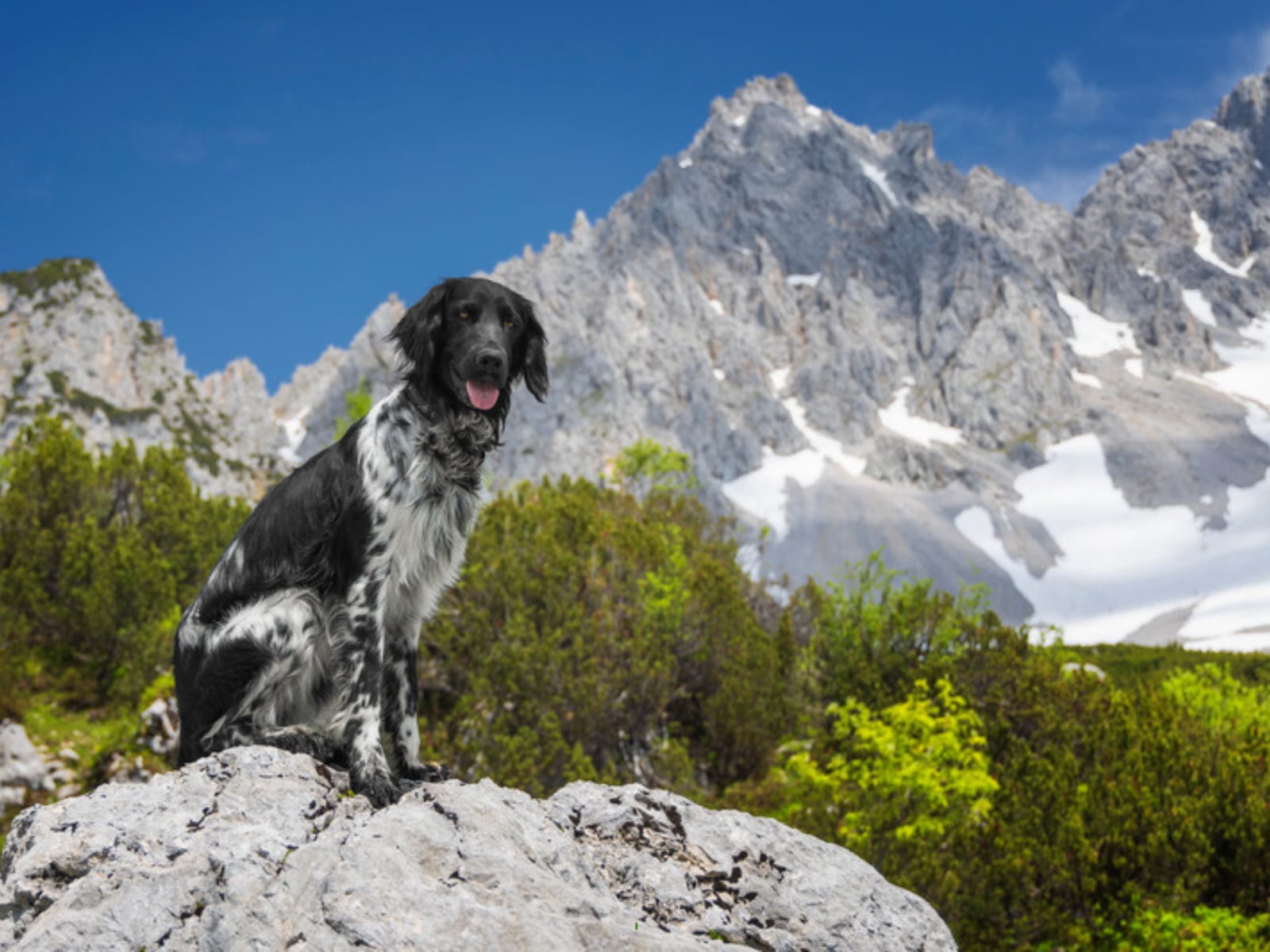
According to the standard, his history goes back to the white and particoloured bird and hawking dogs of the Middle Ages, via the Stöberhund and the Wachtelhund to the pointing dog of the 19th century. With the Small Munsterlander and the German Longhaired Pointer, he belongs to the family of longhaired German pointing dogs. When the German Longhair club excluded black from breeding in 1909, a club founded in 1919 took over the breeding of the black and white longhairs. In 1922 that club began the planned breeding of the Large Munsterlander from a foundation list of 83 dogs. The coat is long, dense and sleek, well feathered on legs and tail. He is white with black patches and flecks, blue roan or solid black; the head is always black. The FCI places him in group 7, section 1.2, continental pointing dogs of the spaniel type, with working trial.
Health
The Royal Kennel Club prioritises genetic diversity and asks for elbow and hip testing. It also recommends eye testing and a DNA test for hyperuricosuria (HUU), a condition that causes bladder stones; imported dogs must be tested for it.
Size
Dogs stand on average 60 to 65 cm, bitches 58 to 63 cm. 2 cm over is tolerated. He weighs about 30 kg.