Character
According to the FCI standard, the Great Dane is friendly, loving and devoted to his owners. He may be reserved with strangers, but the standard requires a confident, fearless, easily handled family dog with high tolerance and no aggression. Socially acceptable behaviour is, in the standard’s words, of the utmost importance.
Origin
As forerunners the standard names the old ‘Bullenbeisser’ and the boar hounds, midway between the heavy English mastiff and the fast greyhound. ‘Dogge’ at first simply meant a large, powerful dog, and the dogs were named by colour and size. In 1878 a committee of seven breeders and judges in Berlin, chaired by Dr Bodinus, decided to group all these varieties as ‘Deutsche Doggen’. The FCI places him in Group 2, section 2.1, molossoid breeds of mastiff type.
Colours
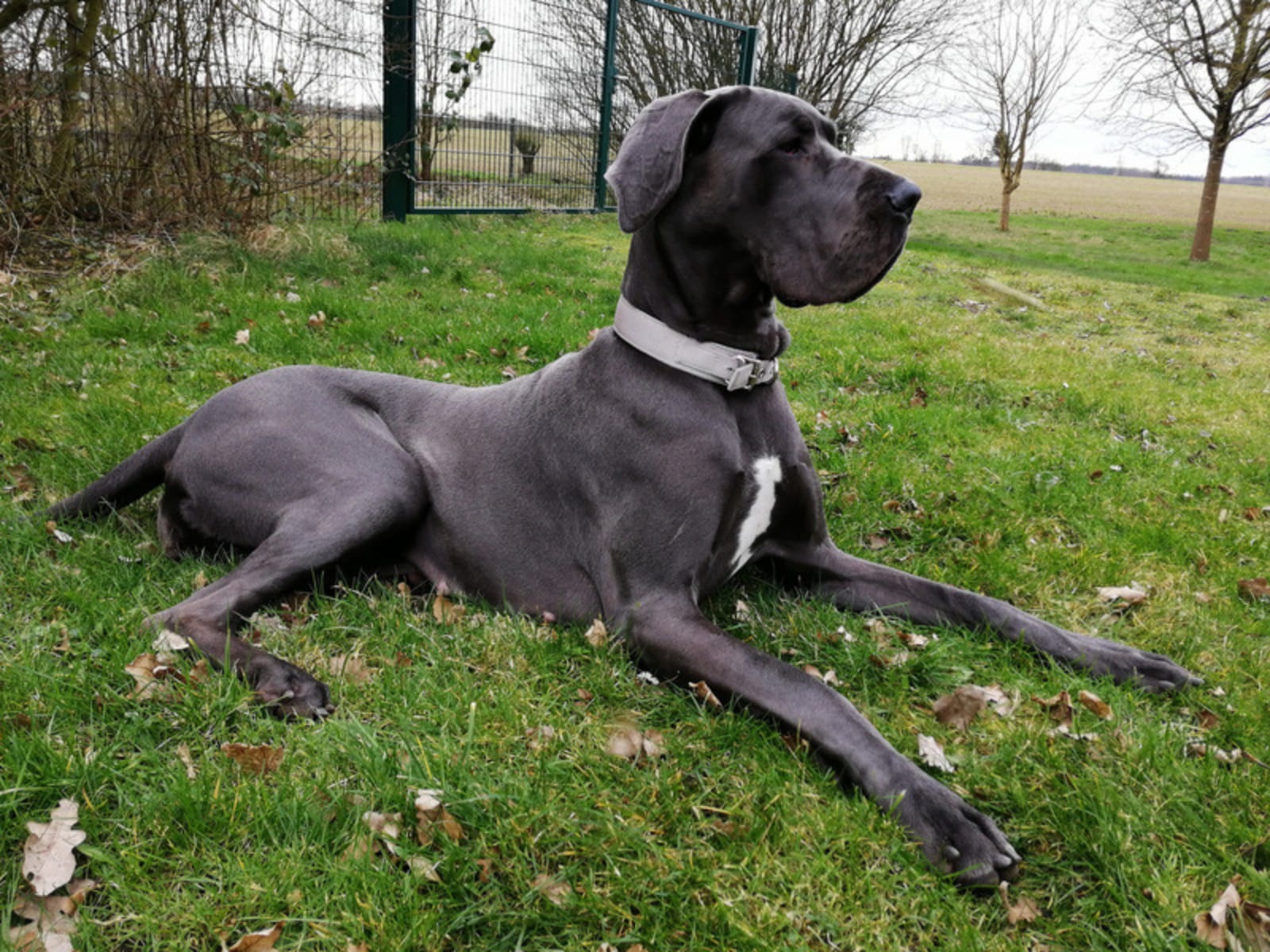
The standard has three colour varieties bred separately: fawn and brindle; harlequin (white with black patches), merle (grey with black patches) and black; and blue.
Health and size
The Royal Kennel Club gives a lifespan of under ten years and recommends hip, elbow and eye testing plus a DNA test for IMGD, an inherited muscle disease. Males measure at least 80 and at most 90 cm, females at least 72 and at most 84 cm.