Character
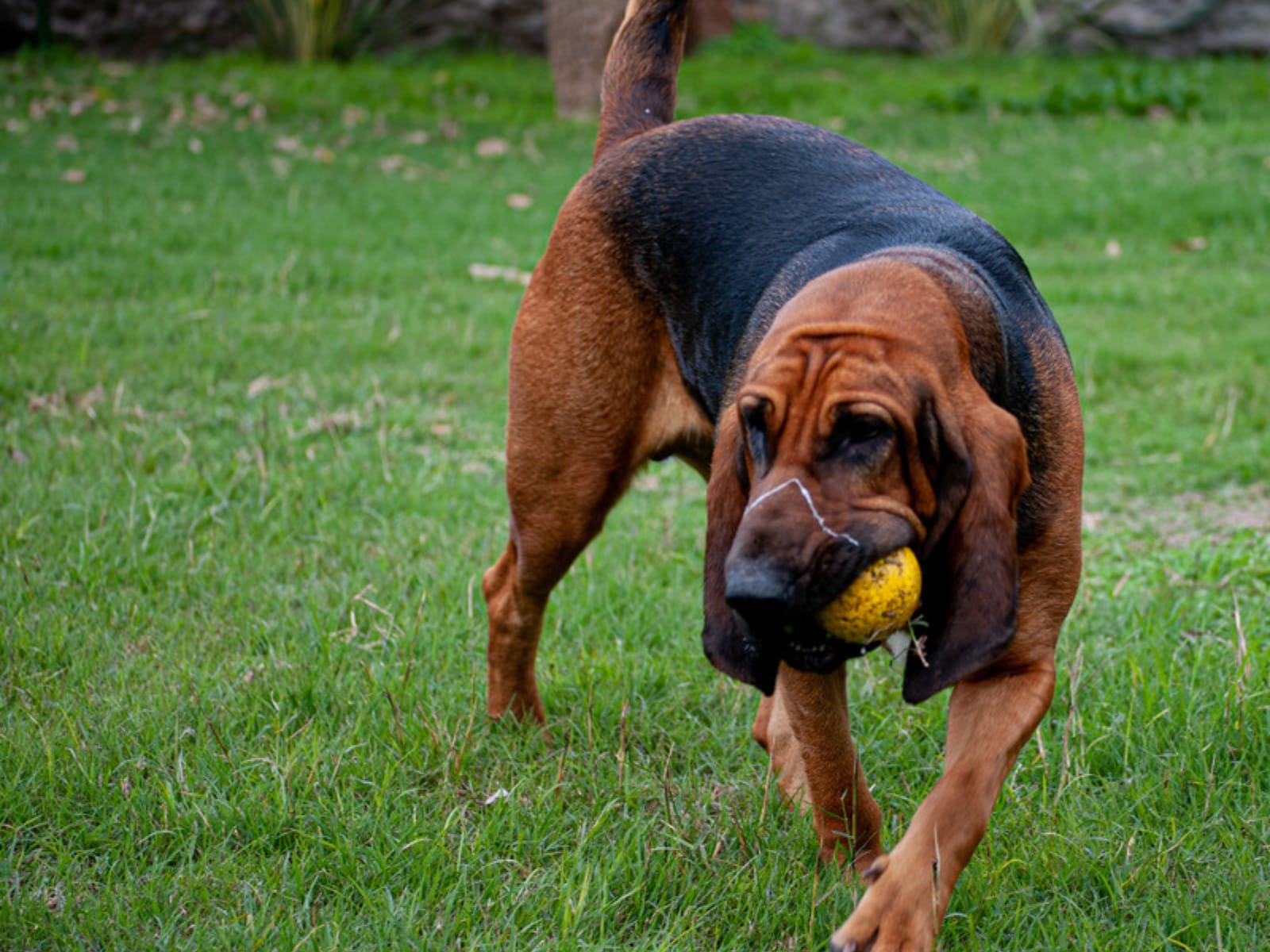
According to the FCI standard, the Bloodhound is gentle, placid, kind and sociable with people. He is particularly attached to his owner and tolerant of other dogs and pets. He is somewhat reserved and stubborn, just as sensitive to compliments as to corrections, and never aggressive. His voice is deep, but he rarely barks.
Origin
He is a large scent hound with very ancient ancestry. He was bred in the Ardennes by the monks of the Abbey of Saint-Hubert. He is presumed to descend from black or black and tan pack hounds used in the 7th century by the monk Hubert, who later became a bishop and, once canonised, the patron saint of hunters. These hounds spread through the Ardennes, rich in big game, and were famed for their toughness when hunting wild boar. According to the Royal Kennel Club, he has been bred in Britain since before 1300, and British hounds helped save the French Chien de St Hubert from extinction in the 19th century. According to its standard, the French Grand Bleu de Gascogne is contemporary with the St Hubert hounds. The Swiss Hound once had a Jura variety of the St Hubert type. The FCI gives Belgium as the country of origin and places him in Group 6, section 1.1, large-sized hounds, with a working trial.
Work
The standard calls him above all a leash hound: he follows the trail of wounded game and searches for missing people in police operations. His build gives him great endurance.
Health and size
The Royal Kennel Club puts genetic diversity first and asks for hip, elbow and eye testing. The RKC gives a lifespan of under ten years. The ideal height is 68 cm for males and 62 cm for females, give or take 4 cm. Males weigh about 46 to 54 kg, females about 40 to 48 kg.