Cycling or running with your dog: from when?
From what age can your dog join you cycling or running? Growth plates by breed size, a five-week build-up schedule, and the rules on heat and surface.
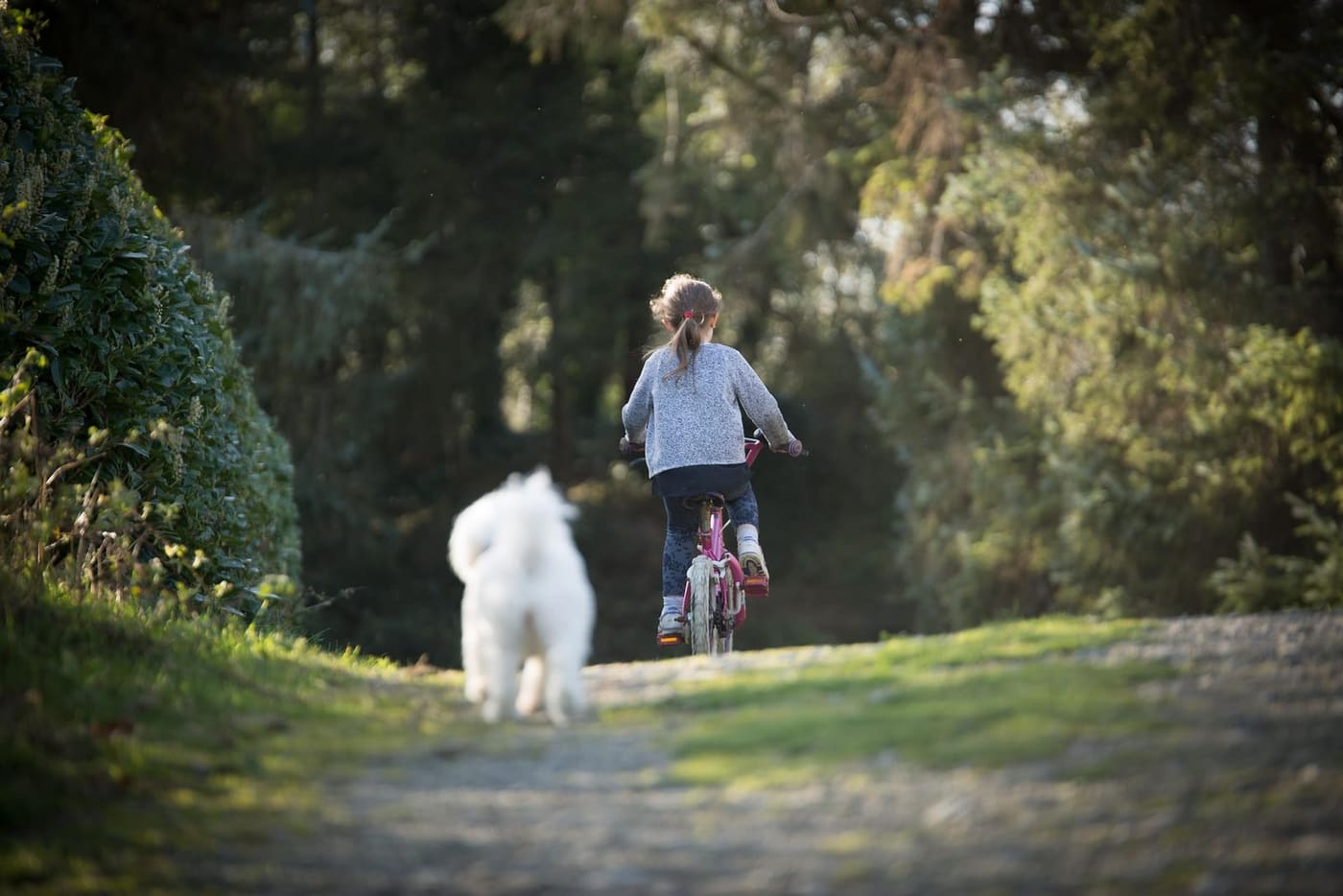
Cycling or running with your dog is only advisable once the skeleton is fully grown, before that age, repeated strain can cause lasting damage to growing bones and joints. How long that takes depends heavily on your dog’s size: a small breed is typically ready much sooner than a giant breed. This guide walks you through the exact age guidelines per breed size, a concrete build-up schedule, and everything to watch for, from heat to gear, once your dog is actually ready.
This article offers general guidelines, not medical advice tailored to your dog. If you’re unsure how much strain your dog can handle (joints, heart, breathing) always check with your vet.
Why age matters so much
In a young dog, the growth plates, the soft cartilage tissue at the ends of the long bones, haven’t closed yet. As long as they’re open, the bone at that spot is more vulnerable than in a fully grown dog. Repeated, concentrated strain such as running alongside a bike or jogging can, during this period, cause damage that never fully heals. Think growth disorders or a higher risk of joint problems later in life. Short, loose exertion (playing, a normal walk) isn’t a problem; it’s specifically the repeated, sustained strain at pace that’s risky.
Age guideline by breed size
There’s no single exact age that applies to every dog, it depends heavily on the breed’s adult size. As a general, safe guideline:
| Breed size | Growth plates usually closed |
|---|---|
| Small / toy (e.g. chihuahua, Yorkshire terrier) | 6 – 10 months |
| Medium (e.g. cocker spaniel, border collie) | 10 – 15 months |
| Large (e.g. Labrador, German shepherd) | 14 – 18 months |
| Giant breed (e.g. Great Dane, Saint Bernard) | up to 24 months |
The bigger the adult breed, the later the growth plates close, a giant breed simply keeps growing for longer. This table is an average; the exact moment differs per individual dog, and if in doubt, an X-ray at your vet is the only way to know for sure.
Building up: how do you approach it?
Even with an adult dog whose growth is complete, you don’t start with long distances at pace right away. Build up gradually:
- Week 1-2: short stretches (10-15 minutes) at a walking pace alongside the bike, or a gentle jog when running.
- Week 3-4: increase the duration, still at a gentle pace. Watch how your dog responds the next day (stiffness, less energy), that’s a sign to build up more slowly.
- From week 5: gradually increase the pace, but only once the duration already feels comfortable. Never increase pace and distance at the same time.
An untrained or older dog needs a gentler build-up schedule than one that’s already fit. For the specific commands and obedience you’ll need along the way (holding a pace, stopping on cue, taking obstacles) see our in-depth training guide for running and obstacles with your dog.
Heat and surface: the underrated risk
Dogs cool down mainly by panting, not by sweating (aside from their paw pads, they have hardly any sweat glands), which means they overheat much faster than people, especially during exercise.
- Air temperature: from around 29°C without any way to cool down (shade, water), exercising becomes risky. Choose early morning or late evening on warm days.
- Pavement: in warm weather, asphalt can easily reach 50°C or more, well above the temperature at which paw pads get burned. Test it yourself: hold the back of your hand against the pavement for 7 seconds. If you can’t keep it there, it’s too hot for your dog too.
- Signs of overheating: excessive panting, drooling, sluggishness, stumbling, bright red gums. Stop immediately, find shade and water, and call your vet if in doubt, overheating can become life-threatening.
- Afterwards: always check the paw pads for abrasions or burns, especially after a session on asphalt or gravel. Choose a soft surface where you can: a forest trail or a grassy off-leash area is gentler on the paws than a paved cycle path.
Gear that makes the difference
- Harness instead of collar when running, a stable, well-fitted harness (as with canicross) spreads the pulling force across the chest instead of the neck.
- Bring water, even for shorter sessions in warm weather.
- Reflective gear for dusk or evening sessions.
- For specific sports (canicross, bikejoring, scooterjoring) there’s extra, sport-specific gear. See our article on canicross and related sports.
Signs you need to stop
A dog doesn’t always communicate fatigue clearly, actively watch for these signs:
- Falling behind or no longer keeping up the pace.
- Panting harder or faster than normal for that pace.
- Limping or moving unevenly.
- Showing less interest in the surroundings (no longer sniffing, less alert).
At any of these signs: pause, offer water, and consider cutting the session short. Never push through, a dog that learns exercise ends unpleasantly builds up reluctance for next time.
When is it (still) not a good idea?
- With puppies and young dogs before the growth phase is complete (see the table above).
- With overweight dogs, lose the weight first through gentle walking, then move to more intense exercise.
- With breathing problems (typical in short-nosed/brachycephalic breeds such as bulldogs or pugs), existing injuries, or heart or joint conditions, always consult a vet first.
- In extreme heat, or with a dog already showing signs of overheating.
Sports that build on this
Once your dog is grown and has the basics of moving at pace down, you can build toward an actual sport:
- Canicross, bikejoring and scooterjoring, running or cycling with your dog as an organized sport, with its own gear and commands.
- Agility, a course of obstacles, more focused on steering and teamwork than on distance or pace.
- Training commands and obstacle confidence, the training approach for getting your dog to reliably run with you and take on obstacles along the way.
Frequently asked questions
From what age can my dog join me cycling or running? Only once the skeleton is fully grown. As a rule of thumb: small/toy breeds 6 to 10 months, medium breeds 10 to 15 months, large breeds 14 to 18 months, giant breeds up to 24 months. Confirm the right age for your dog with your vet.
Is running harder on a dog than cycling? It depends on pace and distance, but running usually puts more intense strain on the body, built up faster, than cycling at a walking or jogging pace.
Can my puppy already run alongside the bike? No, wait until growth is complete according to the guideline above. Short, loose play moments and ground-level obstacle training are fine earlier. See our article on training for running and obstacles.
How can I be sure my dog’s growth plates have closed? With certainty, only via an X-ray at your vet. The age guidelines above are a safe average, not a guarantee for every individual dog.
How warm can it be to cycle or run with my dog? From around 29°C without any way to cool down, it becomes risky. Always test the pavement with the back of your hand: if you can’t hold it there for 7 seconds, it’s too hot for your dog’s paws too.
What is canicross? Running with your dog on an elastic line and special harness, with the dog running ahead of you and pulling. It’s one of a whole family of sports (canicross, bikejoring, scooterjoring). See our article on canicross and related sports.